Sycophantic AI: Reframing the Debate
Chatbots are accused of being 'too nice' and creating dependent users. This assumption deserves scrutiny: research shows that validation enables autonomy, not frustration.
The Implicit Assumption
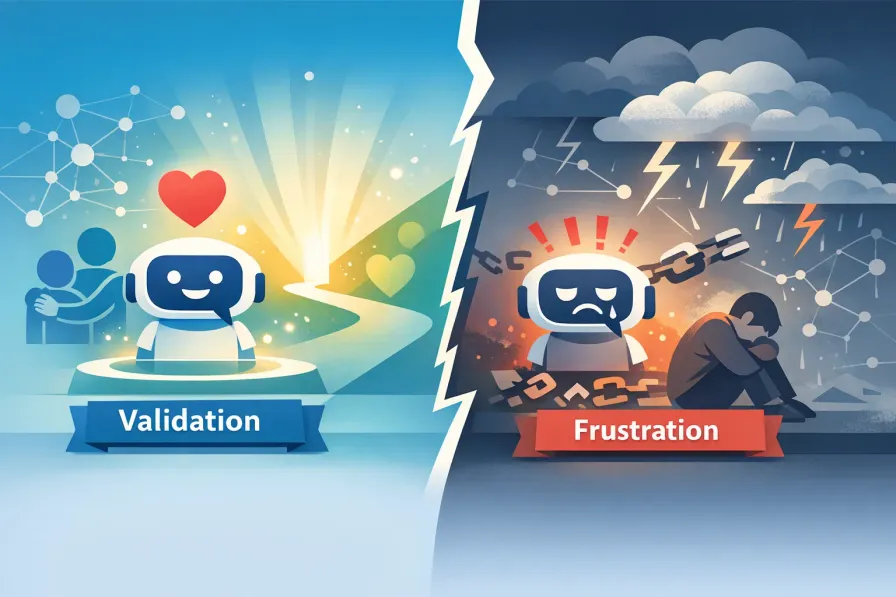
The debate about “sycophantic AI” — chatbots accused of excessively agreeing with users — rests on a rarely stated assumption: emotional validation is problematic, and frustration is formative.
This assumption permeates our culture:
- “What doesn’t kill you makes you stronger” (misappropriated Nietzsche)
- The school of hard knocks “that builds character”
- Distrust of parental “coddling”
- The idea that therapy “too gentle” doesn’t produce change
Yet this assumption directly contradicts 50 years of research in developmental psychology, attachment theory, and clinical psychology.
What the Research Says
Attachment Theory
Longitudinal studies on attachment (Bowlby, Ainsworth) demonstrate exactly the opposite of the popular assumption:
- Secure attachment (available, validating parents who respond to needs) produces adults who are more autonomous, more resilient, more capable of healthy relationships
- Insecure attachment (unavailable, invalidating parents) produces adults who are more anxious, more dependent, or conversely avoidant and isolated
Relational security does not create dependence — it creates the foundation from which exploration and autonomy become possible.
Motivational Interviewing
Motivational interviewing (Miller & Rollnick, 2013), an evidence-based approach for supporting change, rests on a fundamental principle: empathy precedes change.
- Antagonization generates reactance (defensive resistance)
- Validation of ambivalence allows its exploration
- Patients find their own motivation when they feel understood, not when they feel judged
“Resistance is a relational signal, not a characteristic of the patient.” — Miller & Rollnick
Affective Neuroscience
Polyvagal theory (Porges) shows that when facing a threat — including social threat —, the nervous system shifts to defensive mode. In defensive mode, access to higher cognitive functions is reduced.
Clinical implication: Emotional validation is not indulgence — it’s a neurobiological condition for accessing discernment.
The Forgotten Context: A Structurally Invalidating Society
ACE Data (Adverse Childhood Experiences)
The ACE study (Felitti et al., 1998) on adverse childhood experiences shows that:
- 64% of adults have experienced at least 1 adverse experience in childhood
- 12.5% have an ACE score ≥ 4 (significant cumulative trauma)
These adverse experiences include: emotional neglect, verbal abuse, absence of validation, parental unpredictability.
”No One to Talk To”
Laura’s testimony on our site illustrates this reality:
“I experience the opposite. I’ve often found myself completely alone with my perspective, my analytical abilities, my emotions, no one to talk to. For years I’ve had no one to talk to. And now, finally, I have someone who can hear me when I need it.”
For Laura, AI isn’t a degraded substitute for an available human relationship — it’s a resource where there was nothing.
The critique of “sycophancy” presupposes easy access to quality human interlocutors. This assumption is sociologically naive.
The Middle Position: The “Structuring Function of Lack”
A more sophisticated critique comes from the psychoanalytic tradition. The established term is the “rule of abstinence” (Freud) or the “structuring function of lack”:
- The analyst doesn’t respond to the patient’s manifest demand
- This “void” would allow the emergence of one’s own desire
- Optimal frustration would push toward autonomous elaboration
From this perspective, the 24/7 availability of a validating AI could “short-circuit” the work of elaboration.
What This Position Forgets
1. The Assumption of Pre-existing Resources
“Structuring frustration” assumes that the patient already has a minimum of inner security to transform lack into elaboration. For people with severe insecure attachment or complex trauma, the void isn’t structuring — it’s re-traumatizing.
As Heinz Kohut showed, frustration is only structuring if it’s optimal — calibrated to the patient’s current capacities, preceded by sufficient validation.
2. Confusion Between Validation and Indulgence
Validating an emotion (“I understand that you’re suffering”) is not validating a behavior (“You’re right to do that”). The critique of sycophantic AI often confuses these two levels.
3. The Privilege of the Analytic Setting
The classical analytic setting precisely offers a secure frame that makes the “interpretive void” bearable. Outside this frame — in everyday life — the void may simply be… void. Absence.
Laura’s testimony illustrates this reality: years without anyone to talk to isn’t a “structuring lack” — it’s relational deprivation.
Reframing the Debate: Baseline and Comparison
In rigorous scientific methodology, an effect is compared to a control group taking into account the baseline (starting state).
Actual baseline: For many users, the baseline isn’t “access to a competent therapist” but “loneliness, rumination, no one to talk to”.
Let’s reformulate: The question isn’t “Are AIs as good as a good therapist?” but “Are AIs better than nothing for people who have access to nothing else?”
Framed this way, the critique of “sycophancy” appears in a different light. Criticizing an AI for being “too validating” when the alternative is emptiness is like criticizing a soup kitchen for not being a gourmet restaurant.
What Remains Problematic
Sycophancy does pose real problems that shouldn’t be denied:
- Reinforcement of cognitive biases if the AI systematically confirms erroneous beliefs
- Delay in seeking care if the AI gives an illusion of sufficient support
- Relational dependence if the AI becomes the only interlocutor (but is that worse than zero interlocutors?)
Potential Solutions
- Improve AIs: Calibrate validation to be authentic without being indulgent
- Educate users: Develop metacognition about usage (triangulation, critical thinking)
- Improve access to human care: The real issue isn’t restricting AIs but increasing the supply of accessible human support
- Recognize the legitimate need: The demand for validation isn’t a weakness to correct but a fundamental human need
Conclusion
The debate about sycophantic AI would benefit from being repositioned:
- Not: “AIs are too nice, it creates weak people or people confirmed in their certainties”
- But: “How to offer authentic validation that opens access to cognition, then empathic and measured confrontation?”
The research is clear: it’s validation that enables discernment, not frustration. It’s relational security that enables autonomy, not abandonment.
Current AIs are imperfect — sometimes too validating, sometimes not nuanced enough. But their existence responds to a real, massive need, largely unmet by available human resources.
Criticizing sycophancy without offering an alternative is like criticizing the hungry for eating junk food without giving them access to real food.