Autonomy (AI ethics)
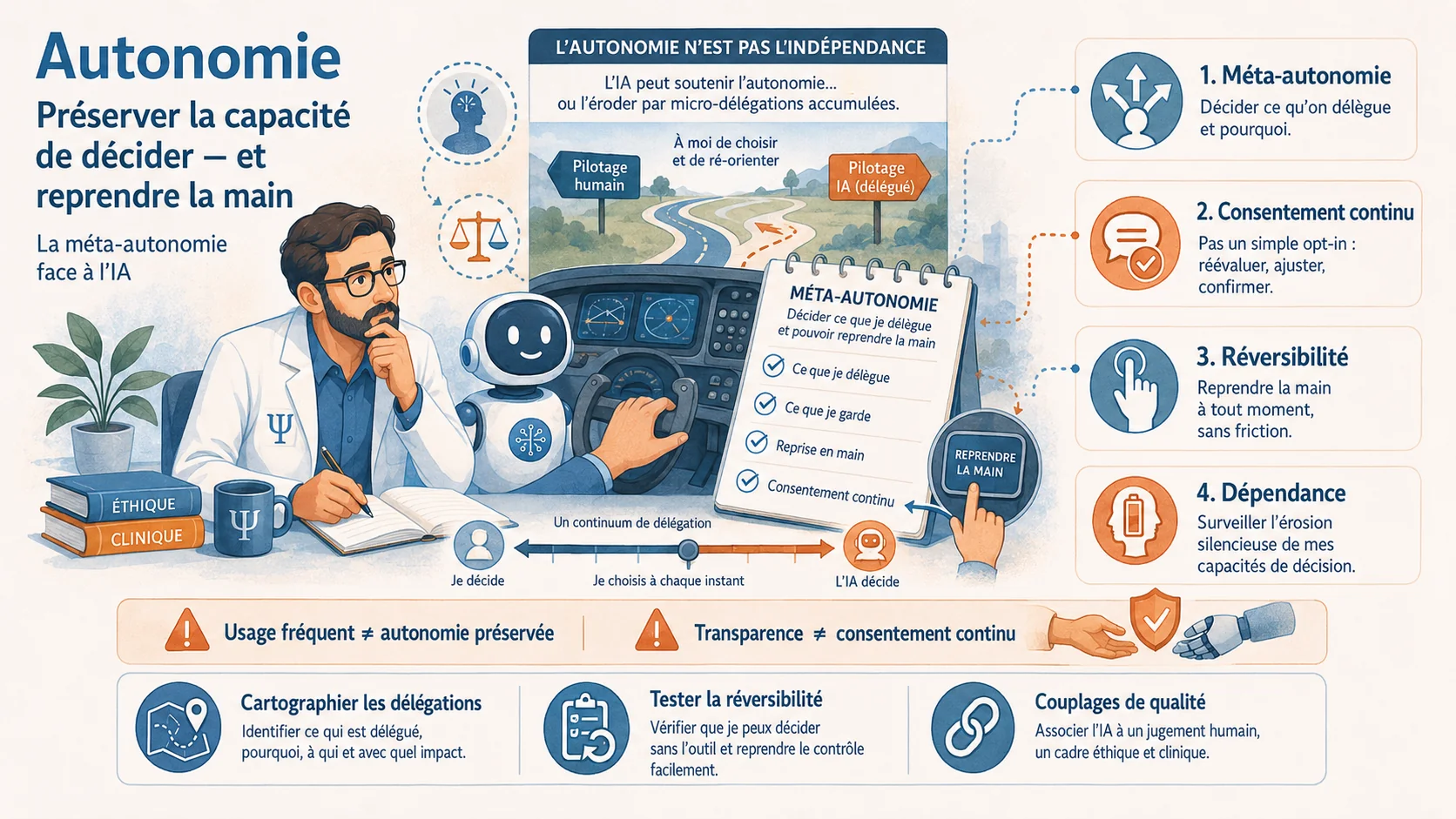
Matthieu Ferry ⇄ IAIn brief: Preserving people’s capacity to decide freely when faced with systems that influence, steer or replace their choices. Floridi and Cowls give an original version: meta-autonomy — the right to decide what one delegates to the machine and to take back control at any time. Not a one-off consent: a continuous contract.
Frame of reference
This principle inherits the liberal-Kantian tradition: an individual, rational and sovereign subject, whose autonomy would be an internal property to protect from influences. This ontology of the isolated subject is the most contested of the five principles — notably by relational approaches. → See other perspectives
Why this concept matters
Patient autonomy is at the heart of your practice — and it is precisely what AI systems work on silently: not through coercion, but through the accumulation of micro-delegations (what to say, what to think of oneself, how to manage a crisis), through amplified biases, through affective dependence.
The innovation of Floridi and Cowls (2019) relative to classic bioethical consent: autonomy in the face of AI is not the initial choice to use a system or not, but the continuous right to redefine the conditions of delegation — meta-autonomy. Human autonomy must be promoted; that of machines, restricted and reversible.
For the clinician, this principle turns a vague worry (“my patient depends on their chatbot”) into precise questions: what has the patient delegated to it? do they know it? can they take back control — and at what cost?
What the principle requires
1. Meta-autonomy: the pilot and the autopilot
Like a pilot who delegates to the autopilot: they choose what they delegate, retain knowledge of the system’s state, and can take back the controls at any time. Eroded autonomy is the pilot who, out of habit, no longer knows how to regain control in a degraded situation.
For the clinician:
For a patient as for yourself: which decisions does the tool pre-format (prioritization, wordings, hypotheses), and would you still know how to make them without it?
2. Continuous consent, not an opt-in
Vilaza and McCashin (2021) spell it out for chatbots: explicit disclosure of the non-human nature and of clinical limits, and the right to escalate to a human at any time, at no cost. The challenge: keeping this consent active in repeated interactions where habit erases vigilance.
For the clinician:
The first-day consent does not cover the 200th exchange. Periodically revisit with the patient what they know, believe and expect of the tool — see the resource Informed Consent and AI.
3. Silent erosion: dependence and misconception
Autonomy is not lost through coercion but through progressive alteration: one-sided attachment to companion chatbots, therapeutic misconception that falsifies consent at the root (one does not validly consent to what one misrepresents), delegated micro-decisions that accumulate.
For the clinician:
The markers to watch: distress when the tool is unavailable, important decisions submitted to the AI before any human, growing inability to elaborate without it.
4. The constitutive tension with beneficence
An application that forces exercises, blocks content or guilt-trips non-engagement “for the user’s good” violates their autonomy. The boundary between a nudge and paternalistic manipulation is thin — and the resolution is not an a priori rule but a situated judgment, ideally co-constructed with the user.
For the clinician:
This tension is familiar to you: it is that of the therapeutic frame itself. Your expertise in balancing scaffolding and empowerment is directly transferable to evaluating tools.
Illustrative case
Thomas, 41, a manager in burnout, uses an AI assistant configured as a “coach”: he submits his delicate emails, his professional decisions, then progressively his personal choices — up to asking it whether or not he should separate from his partner.
Analysis through meta-autonomy: each delegation, taken in isolation, is reasonable and consented to. It is their accumulation that becomes a problem: Thomas never decided to delegate his decision-making life — he slid into it. When his psychologist asks what he would do without the tool, Thomas realizes he can no longer decide on his own even minor choices: the pilot no longer knows how to take back the controls.
No one-off violation of consent, no manipulation: an erosion by drift. The clinical work will consist precisely in rebuilding the capacity to decide — using delegation as material, not as an enemy.
In practice for the clinician
- Map the delegations: ask the patient what they entrust to the tool (wordings? decisions? emotional regulation?) — the list often surprises the patient themselves.
- Test reversibility: the key question is not “how much do you use the tool?” but “what happens when you don’t have it?”.
- Evaluate the quality of the dependence, not its presence: all autonomy is built through scaffolding. The clinical question is whether the dependence on the tool supports the patient’s reflective capacity or replaces it.
- Watch your own meta-autonomy: automatic summaries, hypothesis suggestions, prioritizations — professional tools erode the clinician’s autonomy through the same mechanisms as patients’.
What this concept does not say
Interpretive caveats:
- Autonomy ≠ independence: aiming for the absence of all dependence is a fantasy — it is the quality of dependencies that is worked on
- Transparency is not enough: informing does not restore the balance when the developer holds massive behavioral knowledge (profiling, A/B testing) the user lacks
- Respecting preferences can legitimize manipulation: “they didn’t have to give in to the nudge” is an argument that empties the principle of its substance
- Reverse paternalism exists: invoking autonomy to refuse any framework for vulnerable users (minors, crises) is also a fault — autonomy is not laissez-faire
Other perspectives
The principle inherits a liberal-Kantian subject: individual, rational, sovereign, whose autonomy would be an internal property threatened by external influences. This ontology of the isolated subject is philosophically dated — and clinically false.
Relational autonomy: co-constituted, never solitary
For Mackenzie and Stoljar (2000) and the feminist tradition, agency is always co-constituted by affective, social and technical milieus. A user who develops their reflective capacity via a chatbot is no less autonomous — the real question is the quality of the constitutive dependencies, not their existence.
For the clinician: Replace “does the system make them dependent?” with “does this dependence support or stifle their reflective capacity?”
Extended cognition: delegating is not abdicating
For ecosystemic perspectives and the extended-mind thesis, human cognition has always been distributed — notebooks, relatives, institutions. AI extends this externalization rather than inaugurating it. Autonomy is not decided in the refusal of coupling, but in its quality: reversibility, transparency, diversity of supports.
For the clinician: A patient who externalizes their regulation onto a single opaque system is in danger; a patient who externalizes it onto a rich ecology (relatives, therapist, tools, practices) is not.
The clinical view: autonomy is scaffolded
Developmental clinical work has known it since Vygotsky and Winnicott: autonomy is never a starting point, it is the result of well-woven scaffolding that gradually withdraws. From this angle, the question posed to an AI tool becomes developmental: is it designed to make itself progressively useless — or to make itself indispensable?
For the clinician: The criterion of good scaffolding applies to tools: a beneficent device organizes its own obsolescence in the patient’s life.
These perspectives converge: protecting a fictitious sovereign subject is a poor objective; cultivating quality couplings — reversible, diverse, reflective — is a good one. Floridi’s meta-autonomy, reread this way, remains an excellent tool: it describes exactly the reversibility of the coupling.
Further reading
The ↩ arrows link back to the passage of the resource that cites the reference.
Meta-autonomy: Floridi, L. & Cowls, J. (2019). A Unified Framework of Five Principles for AI in Society. Harvard Data Science Review, 1(1). DOI ↩
The application to CBT chatbots: Vilaza, G. N. & McCashin, D. (2021). Is the Automation of Digital Mental Health Ethical? Applying an Ethical Framework to Chatbots for Cognitive Behaviour Therapy. Frontiers in Digital Health, 3. DOI ↩
Relational autonomy: Mackenzie, C. & Stoljar, N. (eds.) (2000). Relational Autonomy: Feminist Perspectives on Autonomy, Agency, and the Social Self. Oxford University Press. ↩
Erosion through misconception: Khawaja, Z. & Bélisle-Pipon, J.-C. (2023). Your robot therapist is not your therapist: understanding the role of AI-powered mental health chatbots. Frontiers in Digital Health, 5. DOI
All concepts
Last updated: July 2026