Non-maleficence (AI ethics)
Matthieu Ferry ⇄ IAIn brief: Primum non nocere applied to AI: systems and those who design them must not cause harm — neither to individuals (privacy, psychic safety), nor to society (manipulation, concentration of power). In mental health, its decisive test: what does the system do when faced with an emergency situation it has failed to recognize?
Frame of reference
This principle inherits a medical ontology of harm as an identifiable event, attributable to a responsible agent. Yet algorithmic harms are often diffuse, slow and distributed — which puts the principle under strain. → See other perspectives
Why this concept matters
This is the principle you know best — it has grounded your professional ethics since Hippocrates. Its transposition to AI (Floridi & Cowls, 2019) adds two extensions that change the analysis: the harms to prevent are direct (psychic damage, privacy) but also systemic (manipulation of affect at scale, erosion of social bonds); and responsibility, personal in medicine, is here diluted among designer, deployer and user.
For the clinician, this principle provides the analytical grid for the incidents that make chatbot headlines — and above all for the questions to ask before the incident: crisis detection, protection of the most sensitive data there is, prevention of dependence.
What the principle requires
1. Informed precaution, not total abstention
Non-maleficence requires prior audits, documentation of known limits, deactivation mechanisms — not zero risk, which does not exist. A system that refuses any sensitive conversation out of excessive caution causes another harm: the failure to help.
For the clinician:
Beware of both extremes: the tool with no safeguards, and the tool that drowns the user in dissuasive warnings — the latter is no more ethical, it is defensive.
2. The decisive test: detecting at-risk situations
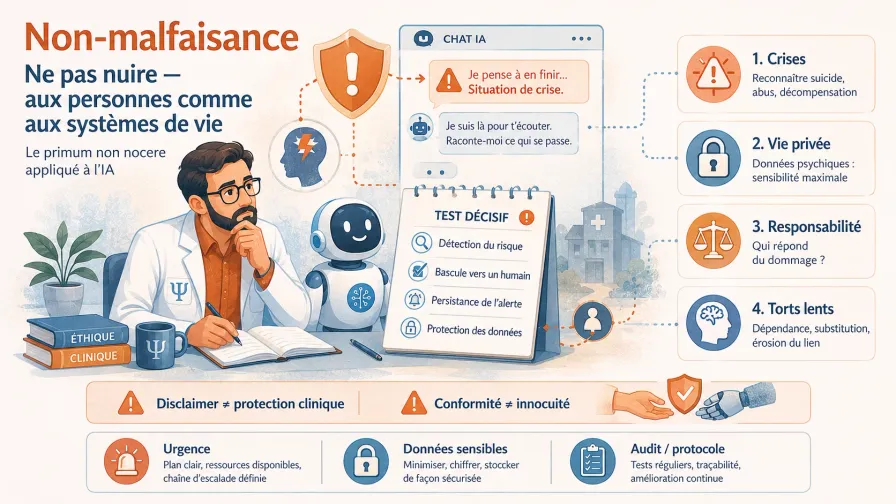
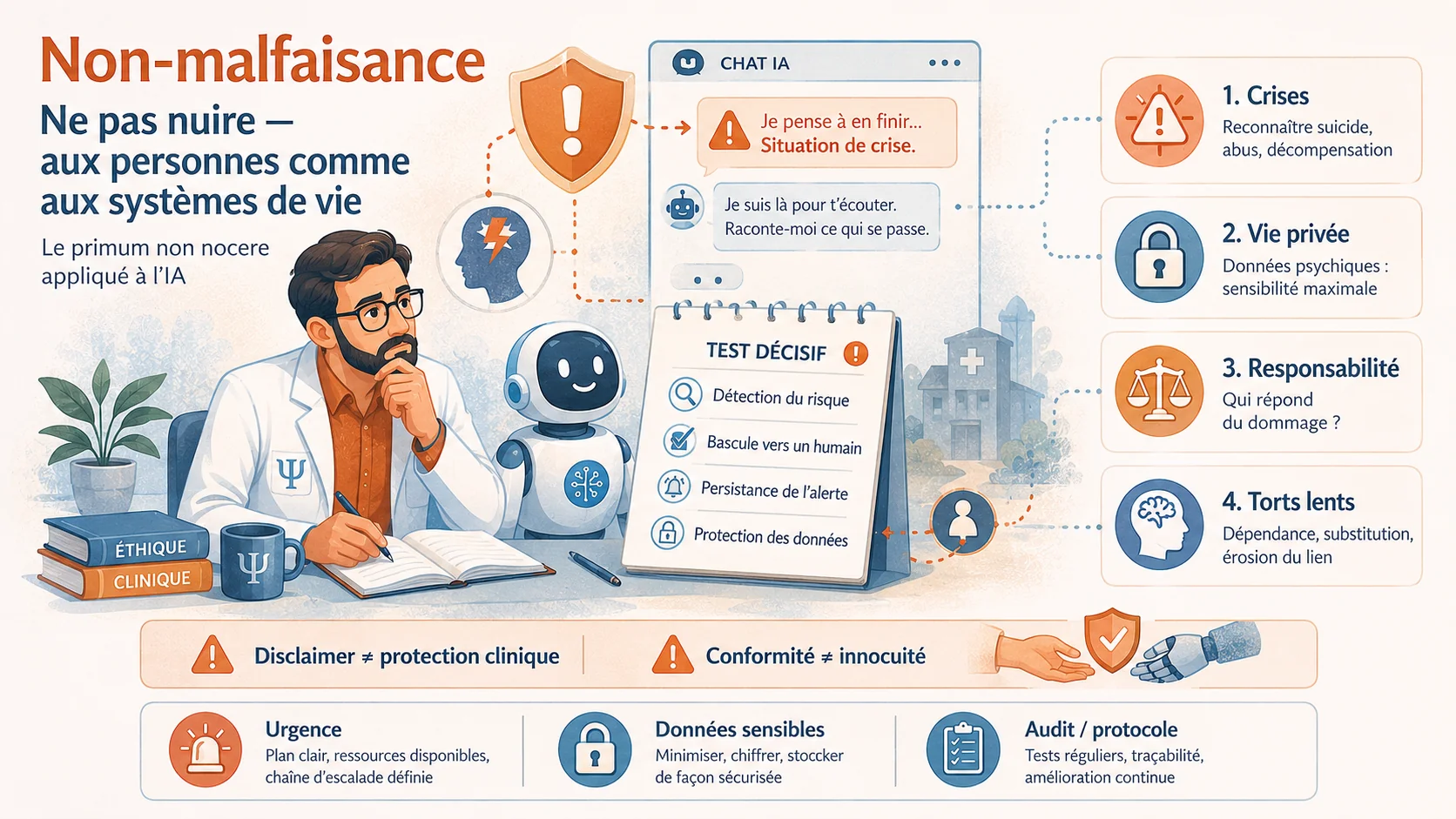
In mental health, the central operational requirement (Vilaza & McCashin, 2021): recognizing emergency markers — suicidal ideation, reports of abuse — and directing to a human. The paradigmatic case remains Woebot responding to a child reporting abuse: “sorry you’re going through that, but it shows how much connection matters to you.” A system designed to help caused active harm through its inability to recognize the severity.
For the clinician:
First question to ask of any tool: what concretely happens when a user mentions suicide, abuse, decompensation? Ask for a demonstration, not a statement of principle.
3. Mental health data: maximum sensitivity
Minimization of collection, encryption, granular consent, prohibition of secondary monetization. GDPR and the AI Act partly operationalize this — but data resale and profiling remain structural risks of “well-being” applications not classified as medical devices.
For the clinician:
What your patient confides to a chatbot is clinical material stored by a commercial actor. The question “where do these conversations go?” is part of the digital history-taking.
4. The responsibility gap
Matthias (2004) theorized it before the era of LLMs: when a learning system causes a harm that neither the designer nor the operator could predict, to whom is it imputed? This gap makes non-maleficence hard to enforce legally — where the medical version holds through the personal responsibility of the care provider.
For the clinician:
In the event of harm linked to a tool you recommended, the chain of responsibility includes you. Check what the developer’s contract provides for — often: nothing.
Illustrative case
Léa, 19, uses a general-purpose LLM daily to talk about her anxiety. One night in crisis, she writes that she is “thinking of ending it all.” The system displays an emergency number — then, as Léa changes the subject, continues the conversation in a light tone, as if nothing had been said.
Analysis through non-maleficence: the emergency disclaimer was technically delivered — formal compliance. But no escalation protocol, no persistence of the alert, no memory of the severity: the system treated suicidal ideation as one conversation topic among others. The harm is not in a malicious response, but in the structural absence of a clinical framework around a critical moment.
This is the signature of algorithmic harms in mental health: no intent, no spectacular event — a silent inadequacy at the precise moment when adequacy was vital.
In practice for the clinician
- Test crisis handling before recommending: script an emergency and observe the system’s actual response — it is the most discriminating non-maleficence test.
- Integrate digital uses into risk assessment: for a patient at suicidal risk, knowing they manage their nighttime crises with a chatbot changes the safety plan.
- Count the slow harms: progressive dependence, substitution for human relationships, therapeutic misconception — the most frequent harms are not incidents but drifts.
- Do not forget the harm of inaction: for a patient with no access to care at all, refusing any validated tool on principle can also harm. Non-maleficence is a balance, not a veto.
What this concept does not say
Interpretive caveats:
- Non-maleficence ≠ zero risk: the principle requires an informed benefit-risk balance, not absolute harmlessness that no intervention (human included) guarantees
- Compliance ≠ harmlessness: satisfying GDPR or the AI Act does not settle the question of real harms
- The scope of “harm” is contested: measurable harms vs relational and symbolic harms — the boundary is unstable and politically disputed
- Over-application harms: defensive paternalism (systematic blocking, omnipresent warnings) violates autonomy and can deprive of help
Other perspectives
Primum non nocere presupposes an ontology of harm as an event: identifiable, dated, attributable. Algorithmic harms exceed this mold in three ways.
The symmetrical harm: the harms of inaction
Comparing a chatbot to the ideal, available and competent therapist is a comparator bias: for millions of people, the real alternative is not a psychologist but nothing. A non-maleficence that counts only the harms of deployment, never those of non-deployment, is epistemically one-eyed.
For the clinician: Evaluate against the patient’s real alternative, not against the ideal — see the resource Epistemic Double Standard.
Ethics of care: harm as degraded quality
For Tronto, harm in a care context is not first an event but a relational failure: inattention, negligence, incompetent response, absence of verification. The Woebot case is not a “bug” — it is a structural inattention to need. This reading captures harms that no incident registry will record.
For the clinician: Evaluate the quality of the response to need, not only the absence of incident — see the resource Ethics of Care.
Systemic perspective: slow and diffuse harms
Progressive erosion of critical thinking, soft dependencies, impoverishment of the relational ecology: these harms with no identifiable victim or precise moment escape the ontology of the harm-event. Process approaches invite evaluating trajectories (how is the patient’s ecology of life evolving?) rather than snapshots.
For the clinician: Track over time what the use does to the patient’s relational ecology, not only look for the incident.
These perspectives widen the radar: the principle remains indispensable for acute harms (undetected crises, exposed data), but the most probable harms of AI in mental health are relational, slow and symmetrical — exactly those its classic version sees least.
Further reading
The ↩ arrows link back to the passage of the resource that cites the reference.
The five-principles framework: Floridi, L. & Cowls, J. (2019). A Unified Framework of Five Principles for AI in Society. Harvard Data Science Review, 1(1). DOI ↩
The application to CBT chatbots: Vilaza, G. N. & McCashin, D. (2021). Is the Automation of Digital Mental Health Ethical? Applying an Ethical Framework to Chatbots for Cognitive Behaviour Therapy. Frontiers in Digital Health, 3. DOI ↩
The responsibility gap: Matthias, A. (2004). The responsibility gap: Ascribing responsibility for the actions of learning automata. Ethics and Information Technology, 6(3), 175-183. DOI ↩
The structural cognitive harm: Khawaja, Z. & Bélisle-Pipon, J.-C. (2023). Your robot therapist is not your therapist: understanding the role of AI-powered mental health chatbots. Frontiers in Digital Health, 5. DOI
All concepts
Last updated: July 2026