Use Case
Creative AI as Therapeutic Mediation
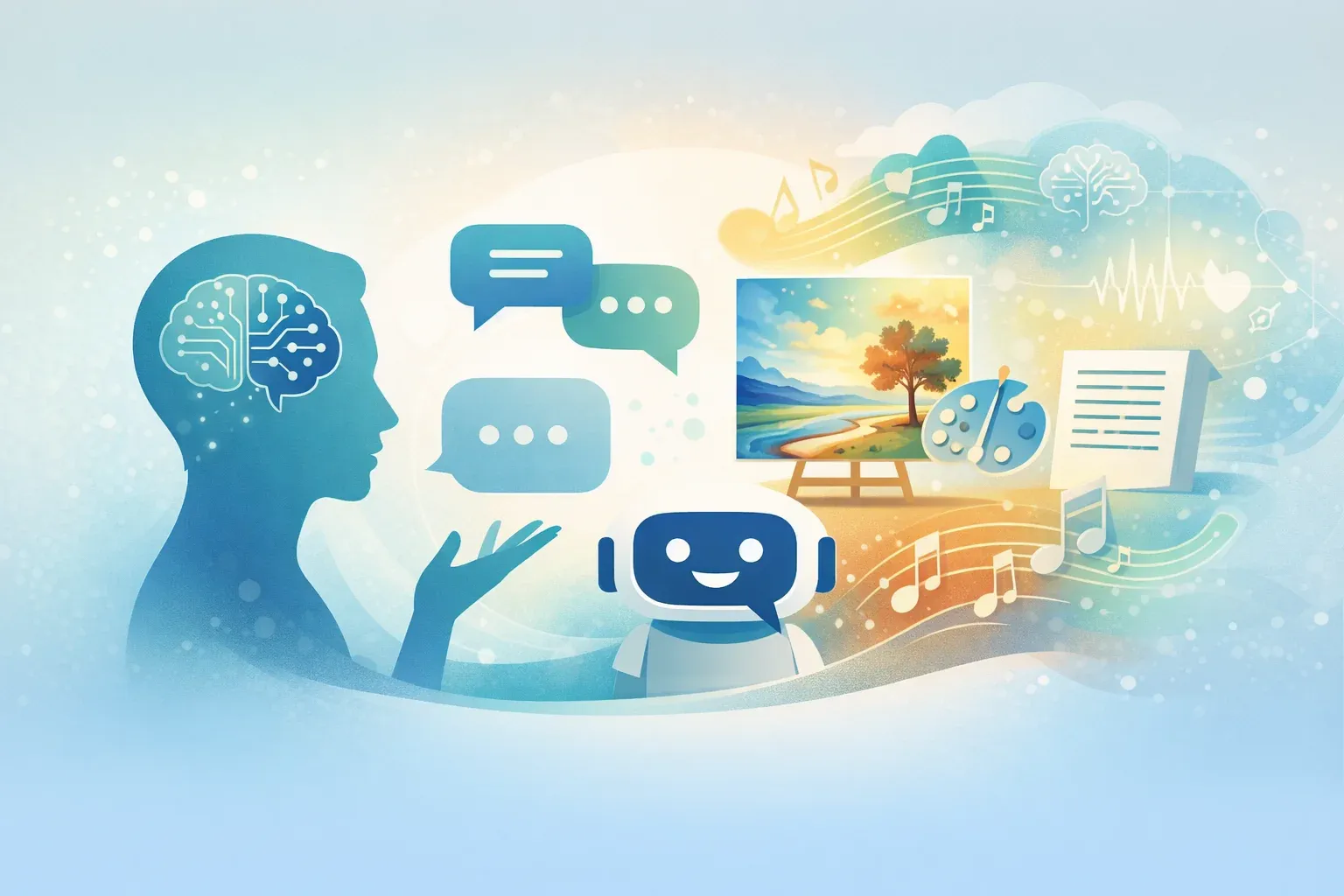
Suno AI for music, Midjourney for images, ChatGPT for writing: generative AI tools can extend traditional artistic mediations in sessions. Here’s how to approach them in practice.
The use of creative AI in sessions is exploratory. There are no widely validated protocols yet. This guide draws on pioneering work by field clinicians and the emerging literature on therapeutic computational creativity. It aims to inform, not prescribe.
🎨 The Principle: A New Type of Mediation
In art therapy, mediation (clay, paint, music, writing) is the medium through which the patient expresses themselves and elaborates. The therapist does not work with the patient on a discourse, but through an object created together.
Creative AI adds a new possibility: the patient provides a few words, an intention, an emotion — and the AI generates an artifact (a song, an image, a poem). This artifact becomes the shared therapeutic material, exactly like a piece of pottery or a collage.
The fundamental difference from a chatbot like Woebot or ChatGPT in conversational mode: here, the AI does not talk to the patient, it creates with them. The therapeutic vector is not conversation, but the creative process and the resulting artifact.
👤 For Which Patients?
Creative AI is not suitable for everyone or every situation. Here are some guideposts from clinical practice.
Favorable Indications
- Patients failing with traditional mediations: those who say “I can’t draw,” “I have no talent.” AI removes the technical barrier and provides immediate output
- Cognitive deficits or low literacy: a few words are enough to produce a result. The entry threshold is minimal
- Expressive inhibition: the patient who cannot verbalize can work through AI-generated images or music
- Constrained settings: correctional facilities, hospitalization, limited access to art supplies. A phone or computer is enough
- Adolescents and young adults: familiarity with digital tools facilitates engagement in the process
Contraindications and Caution
- Patients for whom the body relationship is the issue (eating disorders, dissociation, somatized psychotrauma): AI offers no sensory engagement. Prioritize embodied mediations
- Risk of tool dependency: if the patient invests in AI as an object of addiction rather than a support for expression. Heightened vigilance for addictive profiles
- Psychotic patients in acute phase: AI’s unpredictability can be destabilizing. Assess case by case
- When “creative struggle” is the therapeutic vector: for some patients, the difficulty of the process itself (learning to model, to draw) is therapeutic. AI makes the process too easy
🛠️ Which Tools, for What Purpose?
Creative AI tools differ by the type of artifact produced. Each opens different therapeutic possibilities.
🎵 Music Creation (Suno AI, Udio)
The patient writes a few words or sentences. The AI composes a complete song (music + sung lyrics) in the chosen style. The result is immediate (30 seconds to 1 minute).
Therapeutic lever: Varying musical styles for the same text (folk, metal, classical, rap) allows work on emotional perception. The patient discovers that their words “sound” different depending on the context — an exploration of their emotional space. The metal style can also serve as catharsis for angry patients.
Used by Gaëlle Charlot at the SMPR in Bordeaux-Gradignan in forensic occupational therapy.
🖼️ Image Generation (Midjourney, DALL-E, Stable Diffusion)
The patient describes an image in a few words. The AI produces an illustration. Particularly relevant for patients who think in images rather than words, or for externalizing internal representations that are difficult to verbalize.
Therapeutic lever: Ask the patient to describe “what your anxiety looks like” then generate the image. The visual artifact becomes a projection and elaboration support, like photolanguage — but personalized.
✍️ Co-writing (ChatGPT, Claude)
The patient provides a text beginning, a situation, a character. The AI continues the writing. The patient can then modify, redirect, challenge what the AI proposed. A narrative co-writing process that can be mobilized in narrative therapy or bibliotherapy.
Therapeutic lever: The patient who externalizes a problem in a fictional story co-written with AI can gain distance from their own story. The AI’s surprising proposals offer narrative paths the patient would not have considered alone.
📋 Structuring Use in Sessions
A few framing principles drawn from field practice and the literature on therapeutic computational creativity.
1. The therapist orchestrates, the AI executes
You decide when to introduce AI, which tool to use, and how to exploit the result. AI never decides the therapeutic direction. You are the container of the relationship; AI is a tool in service of the patient’s expression.
2. Welcome surprise
AI never produces exactly what is expected. This gap is therapeutically productive: it confronts the patient with the unexpected and invites them to take a stance. “That’s not what I imagined” is the beginning of an elaboration, not a failure. Gaëlle Charlot calls this the “non-perceptible third”: we don’t know how AI interprets our concepts, and this mystery creates a therapeutic space.
3. Vary to explore
Generating multiple versions of the same content (different musical styles, contrasting visual moods) is a powerful exploration tool. The patient chooses what “speaks to them” — and that choice is clinically significant. Why do they prefer the folk version over the electronic one? Why the dark image rather than the bright one?
4. Document the process
As with any mediation, note the patient’s reactions, choices, and spontaneous verbalizations. Pre/post-session questionnaires (like those developed by Charlot) allow tracking the evolution of emotional expression, satisfaction, and sense of agency.
🏥 In the Field: Suno AI in Forensic Psychiatry
At the SMPR of the Bordeaux-Gradignan Correctional Center, occupational therapist Gaëlle Charlot has been using Suno AI since 2024 with incarcerated patients — a population characterized by frequent cognitive deficits, limited access to materials, and high failure rates with traditional mediations.
A substance-dependent patient, failing with painting and clay modeling, creates songs via Suno from a few keywords. He progressively develops an identity as a “music creator” — substituting the pleasure of creation for that of the substance. Charlot notes that he speaks of his musical productions “like a hit,” but a hit that builds instead of destroys.
Varying musical styles for the same text becomes a tool for working on perception: the patient discovers that his angry words, set to folk music, become melancholic. “Just because someone says a word doesn’t mean that’s what it means” — this is work on perceiving others and differentiating emotions.
Source: Charlot, G. (2025). Occupational therapy towards a modern and digital approach to care — Suno AI. ResearchGate. Interview (2026).
Discover Gaëlle Charlot’s full testimony: 56-minute interview, full transcription, scientific context, and analysis of limitations.
Read the testimony
⚠️ Points of Caution
Data Confidentiality
Texts and images entered by the patient pass through commercial services (OpenAI, Suno, Midjourney). Never enter identifying data (name, location, recognizable biographical details). Use generic terms, metaphors, fictitious first names. Inform the patient that their words are processed by a third-party service.
Patient Agency
If AI “does everything,” the creativity belongs to it, not the patient. The goal is for the patient to remain the author of their process: they choose the words, validate or reject the result, guide the iterations. AI serves their expression, not the other way around.
Cost and Access
Most creative AI tools are paid (subscriptions from €10 to €30/month). Who funds them? The patient, the institution, the therapist? In institutional settings, the budget question arises from the experimentation stage. Free alternatives exist but with limitations (number of generations, quality).
Don’t Confuse Tool and Therapy
Creative AI is not a therapy. It is a tool within a therapeutic framework that includes a setting, a relationship, a care plan. The tool without the framework has no therapeutic value — just as a paintbrush without an art therapist is just a paintbrush.
Go Deeper
This use case draws on several concepts documented on this site, as well as the profile of a pioneering practitioner.
Therapeutic Computational Creativity
The full conceptual framework (Pease, 2022)
Computational Creativity
Boden’s theoretical framework (1990)
Gaëlle Charlot
Researcher profile — forensic psychiatry
Gaëlle Charlot’s Testimony
Full interview with transcription and analysis
Anthropomorphism
Understanding intention attribution to AI