Resources for clinicians
AI & Psychotherapy
Clinical and theoretical reflection on the use of artificial intelligence in mental health.
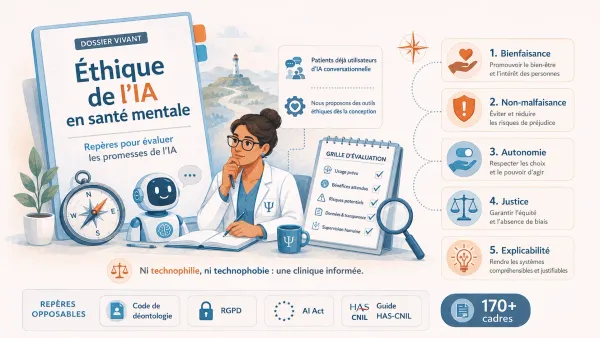
AI ethics in mental health
Your patients already use conversational AI, and vendors promise tools that are “ethical by design.” The five principles of the AIEF framework, their limits as documented by research, an evaluation grid for practitioners and the enforceable benchmarks: professional ethics, GDPR, AI Act, HAS-CNIL.
Explore the dossier →
In the spotlight
AI Watch
All AI Watch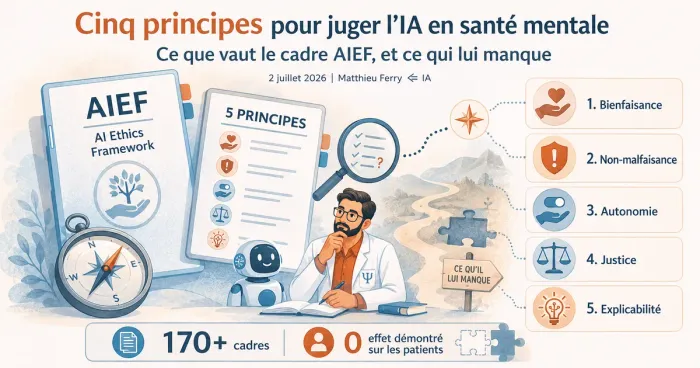
Five principles to judge AI in mental health: what the AIEF framework is worth, and what it lacks
More than 170 AI ethics frameworks published in ten years, zero demonstrated effect on patients. Yet the five-principles framework (Floridi-Cowls) remains the practitioner's best starting point — provided you know what it can do, what it cannot, and how to convert it into an actionable evaluation grid. Founding article of our dossier on the Ethics of AI in Mental Health.
Jul 2, 2026
Testimonials
All testimonialsUser testimonial
Laura
4 months with Claude and ChatGPT
“ It's a source. It's not the truth. It's a tool. ”

Professional testimonial
Jérémy Pellerin
Clinical psychologist, author of Le psychologue artificiel
“ First I study it. Only then do I form an opinion. Not the other way round. ”

Professional testimonial
Roman Malo
Associate professor of clinical psychology
“ We are not facing a new calculator. We are facing something radically new. ”
Key concepts
Social Psychology
Anthropomorphism
Attributing human characteristics to non-humans. Why patients ascribe intentions to AI.
Digital Psychiatry
Digital Phenotyping
Measuring mental health through digital traces. Promises and limits of passive monitoring.
Psychotherapy
Emotional Validation
6 levels of validation in therapy. Understanding why patients feel "heard" by chatbots.

Matthieu Ferry
Clinical psychologist
A unique profile
Triple master's: Mathematics, Computer Science (1996), Clinical Psychology (2018). 15 years of tech entrepreneurship, then a career change to CBT and Schema Therapy. Creator of "Apprendre les TCC" (+50,000 visitors/month).
I understand the intimate workings of AI on a technical level and how to clinically analyze its interactions with patients.
Learn more