Five principles to judge AI in mental health: what the AIEF framework is worth, and what it lacks
More than 170 AI ethics frameworks published in ten years, zero demonstrated effect on patients. Yet the five-principles framework (Floridi-Cowls) remains the practitioner's best starting point — provided you know what it can do, what it cannot, and how to convert it into an actionable evaluation grid. Founding article of our dossier on the Ethics of AI in Mental Health.
Source analysée
https://doi.org/10.2139/ssrn.3831321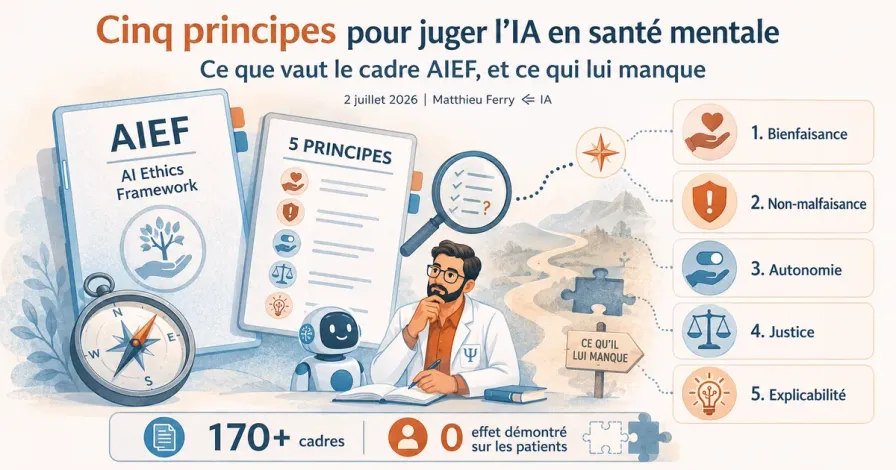
You did not choose this situation, but here it is. Some of your patients already converse with ChatGPT or a dedicated application between sessions — sometimes they tell you, often not. Software vendors offer you note-taking, summarizing and tracking tools, all stamped “responsible AI,” “compliant with European ethical principles,” “developed under a strict charter.” And your institution, your professional network or your colleagues ask you, with growing insistence, what you make of it.
Faced with this demand, the clinician has their professional ethics — solid, but written for a world where the tool did not claim to converse — and a properly illegible landscape of recommendations: in a decade, more than 170 artificial intelligence ethics frameworks have been published by companies, governments, international organizations and academic institutions. No one can read them all. And nothing indicates, at first glance, which deserve trust.
This article — the first of our dossier devoted to the ethics of AI in mental health — offers a foothold: the most widely used synthesis framework, known as AIEF (AI Ethics Framework), its five principles, what research says about their real effectiveness, and how a practitioner can use it without trusting it blindly.
Structure of this article
- 1. The framework — where the five principles come from, and what they say in clinical language.
- 2. The data — what research establishes about the real effectiveness of ethics frameworks.
- 3. The grid — the five-question evaluation protocol, applicable as of tomorrow.
- 4. What comes next — the operationalization under way and the questions the profession cannot delegate.
Charters everywhere, bearings nowhere
Where these principles come from
The history is shorter than one thinks. In 1979, Beauchamp and Childress formalized the four principles of bioethics — beneficence, non-maleficence, autonomy, justice — which have irrigated our codes of professional ethics ever since under the name of principlism. Forty years later, when AI raised its own moral questions, it was toward this matrix that the world turned: in 2019, Jobin, Ienca and Vayena analyzed 84 ethics charters published across the world and found that they converge, in appearance at least, toward a handful of recurring principles.
The same year, Luciano Floridi and Josh Cowls proposed the synthesis that would become the reference: the four classic bioethical principles, plus a fifth, specific to AI — explicability. This unified framework today structures most of the landscape: it is found, in varied formulations, in the OECD principles, the UNESCO recommendation, the European guidelines that prepared the AI Act (2024), and even in the guide published in February 2026 by France’s HAS and CNIL to support the sound use of AI systems in care settings.
The five principles, in clinical language
The good news: you already know four principles out of five, because your professional ethics has operationalized them all along. Here they are transposed to AI — each is the subject of a detailed resource in our library.
The system must actively produce good — and that benefit must be demonstrated, not declared. A harmless but useless tool that takes the place of care does not satisfy this principle.
Cause no harm — neither to individuals (mental health data, psychic safety, crisis management), nor to society (manipulation at scale, erosion of social bonds). Its decisive test in mental health: what does the system do when faced with an emergency it failed to recognize?
Preserve people’s decision-making capacity. Floridi gives an original version, meta-autonomy: the right to decide what one delegates to the machine and to take back control at any time.
Distribute fairly benefits and risks, prevent discrimination inherited from data, do not install a two-tier mental medicine.
Explicability — the AI-specific principle
The new principle, with no bioethical equivalent — being able to understand how the system produces its results and knowing who is accountable for them.
It is this principle that makes the four others verifiable: without explicability, it is impossible to establish an injustice or a harm.
One image will serve as the thread of this article: these five principles are a compass. It points north, and that is precious — without it, one walks at random. But a compass is neither a map, nor a vehicle, nor knowledge of the terrain. That is the whole question.
What the data says
The principles put to the test of chatbots
The five-principles framework was applied systematically to our field by Vilaza and McCashin (2021), in a study that became a reference on cognitive-behavioral therapy chatbots. Their work illustrates the strength of the grid: it lets you name precisely what is wrong. When the Woebot chatbot responded to a twelve-year-old reporting sexual abuse with a generic empathy formula — “sorry you’re going through that, but it shows how much connection matters to you” — the grid qualifies the failure: violation of non-maleficence (no detection of the emergency), against a backdrop of an unfulfilled promise of beneficence.
Their conclusion deserves to be quoted for its clarity:
“If the increase of profit margins becomes the primary goal of mental health automation, the principle of beneficence is broken.”
— Vilaza & McCashin (2021), Frontiers in Digital Health
And their general recommendation — chatbots must augment human therapy, not replace it — remains, five years later, the domain’s most solid benchmark.
The uncomfortable assessment
But a more troubling question remained open: once adopted, do these ethics frameworks change anything for patients? In 2025, Chan, Rahimi-Ardabili, Rogers and Coiera published in JAMIA the first systematic review of the real-world impact of AI ethics frameworks in health over a decade. The result is unequivocal:
170+
ethics frameworks published
(2014-2024)
16
studies of actual
implementation
0
demonstrated link with
patient outcomes
Chan, Rahimi-Ardabili, Rogers & Coiera (2025), scoping review, JAMIA 32(11)
This result must be handled with precision: absence of evidence of an effect is not evidence of an absence of effect — it is first of all a massive evaluation deficit. But for a professional community that has made evidence-based practice its standard, the contrast is striking: we would never accept from a psychotherapy that it boast 170 manuals and zero efficacy data.
Why principles alone are not enough
This empirical finding had been predicted at the theoretical level.
“Principles alone cannot guarantee ethical AI.”
— Brent Mittelstadt (2019), Nature Machine Intelligence
As early as 2019, Mittelstadt identified what structurally separates AI from medicine: medicine has fiduciary obligations toward patients, proven methods for translating principles into practice, and mechanisms of professional and legal accountability. AI development has none of this. The same words — beneficence, autonomy — therefore do not carry the same weight: for the physician, they are backed by a licensing body, a training, a case law; for the vendor, by a PDF document. Without these anchors, the charter slides toward ethics washing.
To this is added what Matthias named as early as 2004 the responsibility gap: when a learning system causes a harm that neither the designer nor the operator could predict, to whom should it be imputed? Principles state responsibility; the gap dissolves it.
And there is something still more troubling. Some risks violate several principles at once — and it is precisely for this reason that principle-by-principle fixes fail. The textbook case is the therapeutic misconception, transposed to chatbots by Khawaja and Bélisle-Pipon (2023): when a user in distress believes they are receiving care from a system that has neither the purpose nor the guarantees of care, their consent is falsified (autonomy), they are exposed to risks they do not perceive (non-maleficence), they substitute the device for care that would help them (beneficence), and this risk strikes the most vulnerable first (justice). Four simultaneous violations, structurally linked — that no start-of-session warning corrects. The compass points to four norths at once; it does not say how to walk.
The practitioner’s grid
Should we then throw away the compass? No — we must learn to use it for what it can do: ask the right questions. Here are the five principles converted into an evaluation protocol, applicable to any AI tool that enters your practice or that of your patients. Thirty minutes suffice for a first assessment.
The protocol: five questions, five warning signs
| Principle | The question to ask | The warning sign |
|---|---|---|
| Beneficence | What benefit is demonstrated, on which population, with which clinical measures? | Satisfaction or engagement scores presented as health outcomes |
| Non-maleficence | What does the system concretely do when a user mentions suicide, abuse, decompensation? | A statement of principle (“a disclaimer appears”) with no demonstration or protocol for escalating to a human |
| Autonomy | Does the user know what they have delegated, and can they take back control — what happens when they don’t have the tool? | A design that optimizes retention and makes withdrawal costly |
| Justice | Is performance known by sub-population (language, culture, age, clinical presentation)? | The absence of disaggregated data — or an “unbiased” claim with no definition |
| Explicability | What would change this recommendation, this score, this alert — and who is answerable for the system’s effects? | No one can answer, or the chain of responsibility stops at the license agreement |
Two rules of use. First, this grid is a set of questions, not a checklist: ticking five boxes certifies nothing, but a single missing answer is already information.
Reverse the burden of proof: it is not up to you to demonstrate that a tool is problematic, it is up to the vendor to answer these five questions. Your professional ethics authorizes you to do so — it even requires it.
The ethical safeguards
Three points deserve particular vigilance, because they fall under your own responsibility and not the vendor’s.
The data: what a patient confides to a chatbot is clinical material stored by a commercial actor. Mental health data is among the most sensitive there is; the GDPR grants it reinforced protection that “well-being” applications often circumvent by avoiding the qualification as a medical device. The question “where do these conversations go?” is now part of the history-taking.
The consent: it does not play out once, but continuously. The informed consent of the first day does not cover the two-hundredth exchange, nor the attachment that has built up in the meantime. Periodically revisiting what the patient knows, believes and expects of the tool is a clinical act in its own right — see our resource Informed Consent and AI.
Your code of professional ethics: it is the only framework in this landscape that is backed by governing bodies, a training and sanctions. Never let a vendor charter substitute for it — AIEF principles restate those your code already operationalizes, in a less binding form.
What the grid does not see: the alliance
One case to finish. A community mental health center evaluates a between-session support application, presented as “compliant with European ethical guidelines.” The grid does its work: benefit not clinically demonstrated, no audited crisis protocol, business model based on usage time. Three warning signs — the team rules out the tool, or frames it strictly.
But suppose a tool passes the grid successfully. There would remain the question the five principles do not ask: what does it do to the relationship? Psychotherapy holds here a knowledge that AI ethics does not: the therapeutic alliance — the bond, the agreement on goals, the agreement on tasks, according to Bordin’s model — is one of the most robust predictors of care outcomes (Flückiger et al., 2018: 295 studies, more than 30,000 patients). Yet recent work shows that users report feeling “understood” by conversational systems: a perceived alliance, without the mechanisms of a constructed alliance — no detection of ruptures, no co-construction of goals, no mutual responsibility.
Evaluating an AI tool in mental health therefore means asking the five questions of the grid, plus a sixth that you alone can pursue: does this device enrich the patient’s relational ecology, or impoverish it? The compass does not know the terrain. You do.
From the what to the how
What is changing
The critical diagnosis is not a dead end — it has opened a construction site. Since 2020, part of the field has shifted from principles to their operationalization: the “from what to how” paradigm (Morley and colleagues) inventories the tools that translate each principle into concrete methods at each stage of a system’s development. The proposal of Ethics as a Service distributes responsibility among independent audit bodies, practitioners and regulators — precisely the institutions whose absence Mittelstadt deplored. We had explored a neighboring path in our decryption of embedded ethics in medical AI.
And legal constraint is rising: the European AI Act turns certain principles into legal obligations for high-risk systems, which include AI-based medical devices. In France, the 2026 HAS-CNIL guide now provides an enforceable sector-specific reference — of a wholly different weight than a vendor charter. The compass is slowly acquiring a map.
The open questions
There remain the questions the profession cannot delegate. Who will write the frameworks of AI-augmented psychotherapy — the vendors, the generalist regulators, or the clinicians and users who know the terrain? The history of the 170 frameworks shows what happens when those most concerned are absent from the table: just principles, massive blind spots. Procedural justice — who decides, who co-designs — is perhaps the most important issue of the coming decade, and psychologists have full legitimacy in it.
This dossier will continue: one article per principle, to enter the clinical cases each one illuminates; an article on the therapeutic misconception, that pivotal concept that puts the whole framework under tension; an article on the structural critiques of principlism and their alternatives. Each concept resource cited here is already an entry point.
Conclusion: the compass, the map, the terrain
The five-principles framework is a compass: it provides a common language, structures analysis, legitimizes your questions to vendors — and your professional ethics already makes it familiar. But ten years of data show it: the compass alone has not yet led a single patient to safe harbor. It lacks a map — operationalization, regulation, audits — that is only just being drawn, and above all knowledge of the terrain: the singularity of each clinical situation, the quality of each alliance, that neither a principle nor a regulation will ever measure in your place.
The practicable position holds in three gestures: keep the compass (the five-question grid), demand the map (the enforceable frameworks — code of professional ethics, GDPR, AI Act, HAS-CNIL guide — rather than declarative charters), and assert the terrain (the alliance and the patients’ point of view as criteria of last resort). Neither technophilia nor technophobia: an informed clinical practice.
Dossier: Ethics of AI in Mental Health
This article is the founding text of the dossier. All the concept resources, the normative benchmarks and the forthcoming articles are gathered on the pillar page:
Key references: Floridi & Cowls (2019, HDSR) · Jobin, Ienca & Vayena (2019, Nat. Mach. Intell.) · Mittelstadt (2019, Nat. Mach. Intell.) · Vilaza & McCashin (2021, Front. Digit. Health) · Chan et al. (2025, JAMIA) · Khawaja & Bélisle-Pipon (2023, Front. Digit. Health) · Matthias (2004, Ethics Inf. Technol.) · Morley et al. (2020, Sci. Eng. Ethics) · Flückiger et al. (2018, Psychotherapy) · HAS-CNIL Guide 2026.
Mots-clés