What France's HAS says (and doesn't say) about AI in mental health
France's health authority (HAS) has published its first recommendations on AI in healthcare and launched an ambitious mental health program. But these two efforts advance in parallel, without ever crossing. Mapping an institutional blind spot that directly concerns psychologists.
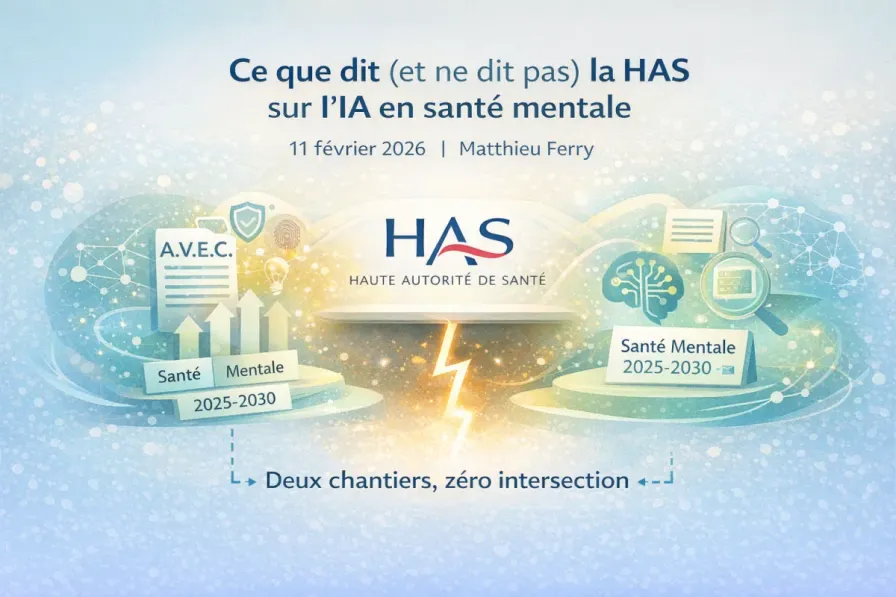
Two efforts, zero intersection
In October 2025, France’s Haute Autorité de Santé (HAS) published an unprecedented document: its first recommendations on the use of generative AI in healthcare, an educational guide structured around an acronym — the A.V.E.C. framework (Apprendre, Vérifier, Estimer, Communiquer — Learn, Verify, Assess, Communicate). The first official French framework on the subject, it was widely welcomed.
That same autumn, the HAS rolled out its Mental Health and Psychiatry Program 2025-2030, the most ambitious in its history. For the first time, mental health was raised to a “flagship theme,” on a par with prevention. Nine areas of work, four structuring ambitions, unprecedented recommendations on schizophrenia — the program is vast.
The problem: neither of these two efforts mentions the other.
The A.V.E.C. framework does not contain a single word on psychiatry, psychotherapy or mental health. The mental health program does not contain a single word on artificial intelligence, digital therapeutics or conversational agents. Two major efforts, two perfectly watertight silos — at a time when ChatGPT is used by millions of people to talk about their anxiety, their depression or their traumas.
This is not a reproach. It is an observation that deserves to be stated clearly, because its implications are concrete for the clinicians we are. When a patient asks you what you think of AI in psychotherapy, you cannot turn to the HAS for an answer. There is none — not yet.
One figure that sums up the situation
More than 84 AI ethics charters have been published worldwide since 2018. None deals specifically with psychiatry or psychotherapy. The HAS is no exception: its work on AI and on mental health advances in parallel, without formal convergence.
This article maps the situation. Not to stir up controversy, but so that clinicians know exactly what exists, what is missing, and what is coming. In eight sections, we will cross the French institutional landscape — from the A.V.E.C. framework to the mental health program, from digital therapeutics denied reimbursement to the France 2030 projects, up to the direct implications for your practice.
What the HAS says about AI: the A.V.E.C. framework
On 30 October 2025, the HAS published its “First keys to using generative AI in healthcare.” This was an event: never had a French health authority produced official recommendations on ChatGPT, Mistral, Claude or any other generative AI system in a care context.
The document is structured around a mnemonic acronym: A.V.E.C. — French for “with,” as in “The sound use of generative AI in healthcare happens WITH the professional.” Four pillars that outline a framework for good use:
Apprendre (Learn)
Master how generative AI systems work through reliable sources. Understand the inherent limits — hallucinations, algorithmic biases, dependence on training data. Get trained in usage modalities and confidentiality rules.
Vérifier (Verify)
Pay attention to the relevance of the use and the quality of the query. Systematic checking of generated content. Never share confidential information. Treat all generated content as potentially erroneous — every output must be verified by the professional.
Estimer (Assess)
Continuous analysis of quality and fit to needs. Assessment of real time saved vs verification time — because verification can cancel out the efficiency gains. Awareness of the environmental impact of these technologies.
Communiquer (Communicate)
Transparency with patients about AI use. Exchanges with colleagues in a continuous-improvement approach. Sharing of experiences and feedback — an indispensable collective dimension in a context where practices evolve fast.
Key quote — HAS, October 2025
”The sound use of generative AI in healthcare happens WITH the professional — AI does not replace clinical judgment, it can assist it subject to systematic verification.”
The framework is complemented by a scoping note from April 2025, prepared in collaboration with the CNIL (the French data-protection authority), which announces joint recommendations for early 2026 on AI in care settings. This HAS/CNIL collaboration is unprecedented and significant: it signals that personal-data protection issues are finally being taken seriously in the field of AI in healthcare.
What the framework covers well: assistance with clinical writing, literature synthesis, professional use of LLMs as assistance tools — in short, the physician or care provider who uses ChatGPT to prepare a report.
What the framework does not cover: use by patients themselves, therapeutic conversational agents, mental health applications, the specifics of psychological data confidentiality (GDPR Article 9 on sensitive data). The guide is designed for somatic medicine — and it does this well. But it leaves a considerable gap for psychiatry and psychotherapy.
What the HAS says about mental health: an ambitious but analog program
The Mental Health and Psychiatry Program 2025-2030 is the third of its kind, succeeding the 2018-2023 program. Chaired by Claire Compagnon, a member of the HAS board, it displays unprecedented ambition: for the first time, mental health and psychiatry are treated as a “flagship theme,” on the same footing as prevention.
The ambition is structured around nine themes and four ambitions:
- Severe disorders: Finally establishing recommendations for schizophrenia and bipolar disorders — unprecedented in France to date
- Vulnerable populations: Children, adolescents, the elderly, psychic disability, refugees
- Prevention: Early detection of at-risk behaviors, anxiety-depressive disorders, suicidal behaviors
- Social participation: Destigmatization, recovery, living conditions
Here are the nine themes selected — and their mention (or not) of digital technology and AI:
| # | Theme | AI/digital mention |
|---|---|---|
| 1 | Schizophrenia and bipolar disorders | No |
| 2 | Child and adolescent mental health | No |
| 3 | Patients’ rights, peer support, therapeutic alliance | No |
| 4 | Support for families and caregivers | No |
| 5 | Mental health of the elderly | No |
| 6 | Psychiatric care for incarcerated persons | No |
| 7 | Mental health, psychiatry and addictions | No |
| 8 | Neurodevelopmental disorders (NDD) | No |
| 9 | Certification of psychiatric facilities | Vague* |
* The only mention of digital technology in the entire program (see below).
Nine themes, zero mention of AI. The only allusion to digital technology is the following:
The only mention of digital technology in the MH 2025-2030 program
”The capabilities of digital technology and the relevance of creating documents intended for users will be systematically examined.”
This wording is limited to the creation of documents, not to therapeutic interventions, diagnosis, follow-up or any clinical use whatsoever. It is also remarkably vague relative to the scale of the program.
It is not for lack of relevance. Take theme 1 (schizophrenia): projects like Emobot work on AI remote monitoring of mood disorders, Theremia on antidepressant-prescription support — but none of these devices appears in the HAS program. Take theme 3 (patients’ rights, therapeutic alliance): the impact of AI on the therapeutic alliance is a major clinical issue — but the program says nothing about it.
The finding is clear: the HAS mental health program is conceived in an analog world. This is all the more striking as the HAS strategic project 2025-2030 itself identifies “AI and digital health” as a cross-cutting priority axis. The cross-cutting reach stops at the doors of psychiatry.
Digital therapeutics in psychiatry: an obstacle course
If the HAS mental health program does not talk about AI, the National Commission for the Evaluation of Medical Devices (CNEDiMTS) has, for its part, received two concrete reimbursement requests for digital therapeutics in mental health. Both received an unfavorable opinion.
| Criterion | Deprexis | HelloBetter Insomnia |
|---|---|---|
| Manufacturer | Ethypharm Digital Therapy | GET.ON Institut (Germany) |
| Indication | Major depression | Insomnia (digital CBT) |
| Evaluation date | December 2021 | July 2024 |
| Decision | Unfavorable opinion (PECAN) | Unfavorable opinion (PECAN) |
| Main reason | ”Mild to moderate” clinical benefit — insufficient vs conventional treatments | Insufficient data to support the presumption of innovation |
| Status in Germany | Reimbursed (DiGA) | Reimbursed (DiGA) |
The Deprexis case is particularly telling. The CNEDiMTS acknowledged that the application “may meet a poorly covered medical need” owing to “significant inequalities in the supply of care and professionals.” For mild depression, the expected service was even deemed “sufficient.” But the commission concluded that the clinical benefit was insufficient for moderate to severe forms — and issued an overall unfavorable opinion.
For HelloBetter, the pattern repeats: a device already reimbursed in Germany, a French pilot that validated acceptability, but data deemed insufficient to support a “presumption of innovation.” A very high standard.
The CNEDiMTS paradox
The commission explicitly acknowledges that inequalities in access to psychological care justify the value of digital therapeutics — then refuses their reimbursement for lack of sufficient evidence according to its own criteria. The need is recognized, the solution is refused. This is not incoherent — the evaluation criteria are what they are. But the question deserves to be asked: are these criteria, designed for drugs and medical imaging, suited to digital psychological interventions?
The international comparison is harsh for France:
| Criterion | France (CNEDiMTS) | Germany (DiGA) |
|---|---|---|
| Reimbursed mental health DTx | 0 | 30+ (incl. Deprexis, HelloBetter) |
| Evaluation framework | Classic medical-device criteria (high level of evidence) | DiGA fast-track (12 months of real-world evidence) |
| Typical timeline | Several years + high risk of refusal | 12 months (provisional listing) then reassessment |
| Philosophy | ”Prove first, reimburse later" | "Reimburse to prove in the real world” |
The point is not that the German model is superior — the DiGA system has its own limits (delistings for insufficient data, criticism of app quality). But the question is posed: how do you correctly evaluate a digital psychological intervention when the criteria were designed for hip prostheses and CT scanners? The comparator used (usual care + digital therapy vs usual care alone) radically changes the conclusion depending on whether you compare with “nothing at all” or with in-person CBT — which most patients never obtain, for lack of available therapists.
For further insight into evaluation models for mental health applications, see our analysis of the APA model.
France 2030: three projects that change the game?
If the HAS has not yet crossed AI and mental health, the French state has sent a strong political signal. In September 2025, as part of the France 2030 plan, three winning projects of the call for proposals “Digital medical devices in mental health” were announced, funded by BPIfrance.
Theremia — Decision support for antidepressants
Target: Depression in young adults
Technology: AI algorithm co-developed with INRIA, exploiting real-world data
Innovation: Reduce therapeutic delays by helping prescribers choose the right antidepressant faster. Validation by clinicians and patients.
Emobot (EMOCARE) — Passive remote monitoring of mood disorders
Target: Depression and mood disorders
Technology: Multimodal AI — analysis of face, voice, sleep, physical activity
Innovation: The first medical device for passive, continuous and objective remote monitoring of mood disorders. Real-time relapse detection without patient intervention. The REMOOD study is under way, aiming for CE marking.
Resilience / Edra PRO — Remote monitoring in psychiatry
Target: Major depressive episode under medication
Technology: Structured and personalized follow-up, with budget-impact analysis
Innovation: Large-scale deployment of psychiatric remote monitoring. Clinical study under way to demonstrate the clinical and health-economic benefits.
These projects are promising. But three observations stand out:
They all target depression. The three projects focus on depression or mood disorders. None addresses anxiety, PTSD, eating disorders, addictions or psychosis. This is understandable — depression is the most prevalent and best-documented disorder. But it leaves immense needs uncovered.
None is digital psychotherapy. The three devices fall under remote monitoring or medical decision support. None offers direct therapeutic interaction with the patient — no digital CBT, no chatbot, no psychological support. This is a realistic choice (evaluation is easier for remote monitoring than for psychotherapy), but it maintains a blind spot on the tools patients already use daily — ChatGPT, Replika, Character.AI.
They will run into the same criteria. In 3 to 5 years, these devices will have to go before the CNEDiMTS to obtain reimbursement. The same criteria that refused Deprexis and HelloBetter will apply. The question is open: will the evaluation have evolved by then?
Why this concerns us directly
Everything above may seem institutional, abstract, remote from the office or consulting room. It is not. The choices (and non-choices) of the HAS have very concrete implications for mental health clinicians.
What the A.V.E.C. framework does not cover in psychiatry
| What A.V.E.C. covers | What A.V.E.C. does not cover in mental health |
|---|---|
| Professional use of AI (writing assistance, synthesis) | Use by the patient (ChatGPT for their depression, Replika as a confidant) |
| Verification of generated content | The risk of attachment and transference toward a conversational AI |
| General confidentiality (not entering patient data) | The reinforced confidentiality of psychological data (GDPR art. 9, sensitive data) |
| Transparency with the patient about AI use | The impact of AI on the therapeutic alliance and the care frame |
| Continuing professional training | Informed consent in a situation of psychic vulnerability |
Five questions with no institutional answer
1. What do you say to a patient who uses ChatGPT to “talk” about their depression? The A.V.E.C. framework covers only professional use. For patient use — the use that is multiplying — you are on your own. No HAS recommendation guides you.
2. How do you handle transference toward an AI? Some patients develop forms of attachment to conversational agents — projection of empathy, expectation of permanent availability, a feeling of betrayal when the service changes. This is a real, documented clinical phenomenon, and totally absent from regulatory frameworks.
3. What position on psychological data in LLMs? A patient who types their intrusive thoughts into ChatGPT confides them to OpenAI. Article 9 of the GDPR classifies health data as “sensitive” — but is the required informed consent really possible or desirable when a patient in distress uses a free tool at 2 a.m.? An occupational therapist in prison psychiatry told us of a patient who, rope in hand at 3 a.m., chose to talk to ChatGPT rather than act — “you gave me a way not to die.” This case, obviously anecdotal, raises a question regulation will have to confront: how do you assess the cost of the absence of access to these tools in the event of overly restrictive regulation?
4. What does the 6th-cycle certification change for psychiatry? Since September 2025, psychiatric facilities must meet digital criteria in their HAS certification — governance of digital medical devices, telemedicine, innovative tools with AI. This is the most concrete mechanism by which AI enters institutional psychiatry. But the risk of superficial adoption (“ticking the box”) without ethical reflection is real.
5. How do you think about digital technology without cognitive capture? The risk, for clinicians as for institutions, is to adopt a defensive stance (reject everything) or, conversely, an enthusiastic one (accept everything) without the nuanced analysis the situation demands. Neither technophobia nor technophilia: that is the space we are trying to open here.
To go deeper into these ethical issues
We have devoted several concept resources to these questions. The ethics of care offers a complement to classic principlism for thinking about the patient-AI relationship. Informed consent in the age of AI details the specific issues. Our article on embedded ethics explores how to integrate ethics directly into development teams.
For a clarification of the technical terms often confused (AI, chatbot, LLM, agent), see our terminological guide. And for insight into the risks of attachment to AI, our analysis of sycophantic AI explores the phenomenon of systematic validation.
What is coming: the timeline to watch
The institutional blind spot we describe is not necessarily permanent. Several milestones could bring the HAS’s AI and mental health efforts together. Here is the timeline to watch.
AI recommendations in care settings (HAS + CNIL)
The joint HAS/CNIL recommendations, announced in the April 2025 scoping note, are expected to be published in early 2026. This is the most anticipated document. Key question: will psychiatry be mentioned in its scope?
Relevance reference frameworks — LFSS 2026, Art. 84
The 2026 Social Security financing law tasks the HAS with creating “relevance reference frameworks” for the public funding of decision-support systems. This is the framework that will determine which AI tools are eligible for reimbursement.
National mapping of AI uses in healthcare
Planned in the National Strategy for AI and Health Data 2025-2028. This stock-take could reveal the scale of informal AI use in psychiatry — and force institutional convergence.
Advance directives in psychiatry
The HAS working group on advance measures in psychiatry (allowing patients to express their care preferences in advance in case of a crisis) will report in September 2026. The effort does not mention AI — but digital tools could be a natural vector for these advance directives.
Results of the France 2030 projects
Theremia, Emobot and Edra PRO should have completed their clinical trials and applied for CE marking. That is when the question of reimbursement — and thus of going before the CNEDiMTS — will arise concretely.
Our position
Let us sum up. The HAS is doing considerable work. The A.V.E.C. framework is a welcome first framework for generative AI in healthcare. The mental health program 2025-2030 is the most ambitious in the institution’s history. The recommendations on schizophrenia, unprecedented in France, had been awaited for years.
But these two efforts advance in silos. And this blind spot has concrete consequences for mental health clinicians, who find themselves without an institutional framework in the face of questions already raised by their patients.
We are neither in easy criticism nor in complacency. We are in substantiated observation and constructive proposal. Here are our three recommendations:
Integrate an AI/digital axis into the HAS Mental Health program
The 2025-2030 program has nine themes. None addresses digital technology or AI. We recommend adding a cross-cutting “digital and AI in mental health” axis that would run through the nine existing themes — not an isolated tenth theme, but a dimension systematically examined in each of the nine. The HAS has, moreover, done this for certification (6th cycle): the same principle should apply to the recommendations program.
Adapt the A.V.E.C. framework to the specifics of mental health
The A.V.E.C. framework is generic and designed for professional use in somatic medicine. Psychiatry and psychotherapy raise specific issues that deserve a dedicated version: heightened psychic vulnerability, risks of attachment and transference, reinforced confidentiality (GDPR art. 9), impact on the therapeutic alliance, direct use by patients. An “A.V.E.C. for mental health” would be a valuable tool for clinicians.
Rethink the CNEDiMTS criteria for digital therapeutics
Two digital therapeutics in mental health evaluated, two unfavorable opinions. Zero reimbursed mental health DTx in France, versus more than 30 in Germany. The current evaluation framework, designed for classic medical devices, struggles to grasp the specifics of digital interventions in mental health. The LFSS 2026 and its “relevance reference frameworks” are an opportunity to rethink these criteria — notably the question of the comparator (what is the reference care when patients access no care at all?) and the standard of evidence (innovation vs efficacy + accessibility).
These proposals are not revolutionary. They are pragmatic, realistic and directly anchored in the HAS’s ongoing work. The institution has the competence and the legitimacy to carry out this work — it is a matter of connecting two efforts that, today, ignore each other.
In the meantime, mental health clinicians do what they have always done: navigate without an institutional compass in a landscape that changes faster than regulatory frameworks. It is precisely to support them in this navigation that this site exists.
Update — March 2026
The joint HAS-CNIL guide “Supporting the sound use of artificial intelligence systems in care settings” (February 2026) confirms and amplifies the blind spot identified in this article. The word “psychotherapy” does not appear in it even once. Our detailed analysis — consent, professional secrecy, fictitious human oversight — can be read here: What the HAS-CNIL guide reveals (and hides) about AI in psychotherapy.
References and sources
HAS documents
- A.V.E.C. framework — First keys to using generative AI in healthcare (Oct. 2025, upd. Dec. 2025)
- A.V.E.C. press release — First keys to using generative AI in healthcare (Oct. 2025)
- Scoping note — AI in care settings: supporting uses (Apr. 2025)
- MH program — Mental health and psychiatry 2025-2030 (2025)
- AI medical-device grid — Evaluation grid for AI-based medical devices (2020, upd. 2022)
- Deprexis — CNEDiMTS evaluation (Dec. 2021)
- HelloBetter — CNEDiMTS evaluation (Jul. 2024)
- 6th-cycle certification — Digital criteria (Sept. 2025)
- Advance directives — Work in psychiatry (2025-2026)
- HAS strategic project — 2025-2030 (2025)
Other sources
- France 2030 — Call for proposals: Digital medical devices in mental health (Sept. 2025)
- National Strategy — AI and health data 2025-2028
- Santé Mentale Magazine — Mental health, a flagship theme for the HAS (Feb. 2025)